|
GR8677 #72
|
|
|
Problem
|
|
 |
Wave Phenomena }Group Velocity }Group Velocity
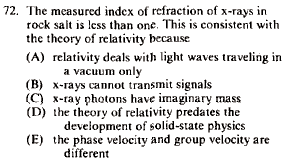
Recall the definition of index of refraction  in terms of the speed of light in vacuum in terms of the speed of light in vacuum  and the velocity of the light in medium and the velocity of the light in medium  , ,  . Since the velocity of light in any medium is . Since the velocity of light in any medium is  , the condition , the condition  usually holds. However, even if rock salt has usually holds. However, even if rock salt has  , the wave does not exceed the speed of light. The group velocity can travel faster than the speed of light, and apparently it is the group velocity at work in the equation . , the wave does not exceed the speed of light. The group velocity can travel faster than the speed of light, and apparently it is the group velocity at work in the equation .
One can also arrive at this conclusion via MOE (Method of Elimination):
(A) Relativity is a pretty general theory that supposedly applies everywhere. (Newtonian mechanics can be achieved using the proper approximation technique.) X-out this choice.
(B) An x-ray is a specific frequency in the electromagnetic spectrum. Nothing forbids an electromagnetic wave from transmitting signals, and thus this choice is out.
(C) Imaginary mass? If confused, save for last comparison.
(D) Historical precedence shouldn't change the correctness of a theory (at least not in the ideal world ETS lives in)... X-this out.
(E) One recalls that there's a difference between group and phase velocities. Could this difference allow one of them to exceed the speed of light? Probably. In either case, this is a much better choice than the other remaining candidate, choice (C). So, choose this.
|
|
|
Alternate Solutions |
| There are no Alternate Solutions for this problem. Be the first to post one! |
|
|
Comments |
kpb
2009-12-18 12:55:18 | Refractive index= C/V
group velocity is always less than C, so refractive index is less than one. But phase velocity can be more than C, hence refractive index can be greater than one. so the result E makes sence. For better explanation, please see the link below.
http://www.mathpages.com/home/kmath210/kmath210.htm
kpb
2009-12-18 13:20:28 |
Please ignore the above explanation.
Refractive index= C/V, group velocity is always less than C, so refractive index is greater than one. But phase velocity can be more than C, hence refractive index can be less than one. so the result E makes sence. For better explanation, please see the link below. http://www.mathpages.com/home/kmath210/kmath210.htm
|
|  | gliese876d
2008-10-17 11:37:38 | I have to say I just laughed out loud at the "imaginary mass" choice :)
neon37
2010-11-03 12:29:03 |
yea me too, now I'm wondering if there is any deeper meaning to this other than a mere pun.
|
acukierm
2013-10-18 20:08:13 |
Actually this answer does kind of make sense. If n<1, then since  , it seems like the velocity of the photons is greater than c. Recall that for a massive object, , it seems like the velocity of the photons is greater than c. Recall that for a massive object,  . But . But  = = . So if v>c, then is imaginary! And since . So if v>c, then is imaginary! And since  must be real, that implies that must be real, that implies that  is imaginary. Of course photons have zero mass so this is all nonsense, but this answer is actually the most plausible of all the other wrong ones. is imaginary. Of course photons have zero mass so this is all nonsense, but this answer is actually the most plausible of all the other wrong ones.
Objects that travel faster than c are called tachyons. Laugh all you want, but a lot of string theorists believe that tachyons do exist, and that they have imaginary mass.
|
| | nitin
2006-11-16 12:10:49 | No! The group velocity  cannot be greater than c, and it is not which is "at work in the equation n=c/v". Concerning the latter, if cannot be greater than c, and it is not which is "at work in the equation n=c/v". Concerning the latter, if  , then we have , then we have
 , ,
which is called the "group index", and which is NOT the commonly known refractive index . Instead, is defined with respect to the phase velocity  . .
prismofmoonlight
2007-10-28 13:21:58 |
To clear things up, the index of refraction n=c/v_phase. rnrnn<1 does not violate the theory of relativity, which says that no information-carrying signal can propagate faster than c, because it is v_group that describes the velocity of the transmitted information.
|
prismofmoonlight
2007-10-28 13:22:43 |
That's just supposed to be n<1 in the second line.
|
temujin
2008-10-28 15:31:02 |
speed of light in a material is less than c; so, the group velocity in the medium can be greater than the the speed of light (for that medium).
|
Jeremy P
2008-11-04 10:53:01 |
nitin is right.rnrn carries information and so cannot travel faster than rnrn carries information and so cannot travel faster than rnrn carries no information and is greater than rnrnuse carries no information and is greater than rnrnuse  to arrive at n<1 to arrive at n<1
|
Setareh
2011-10-27 01:43:48 |
I do agree with the guys who believe this is the phase velocity which can be faster than the speed of light. We also got familiar with this fact in electromagnetic and optics..
|
| | globalphysics
2006-10-29 22:19:21 | Shouldn't it be n<1 for the 4th line?
zeper
2011-08-07 08:10:14 |
yes it must have been n<1
|
zeper
2014-09-18 03:53:50 |
correction: no it is true in the answer.....n>1 so vc why? this was the question.
|
|  |
|
|
|
|
The Sidebar Chatbox...
Scroll to see it, or resize your browser to ignore it... |
|
|
|