|
GR9277 #51
|
|
|
|
|
Alternate Solutions |
carle257
2010-04-09 23:45:01 | Also recall that the solutions when taken as pure states of only one n form stationary states of which the time derivative of all expecation values will be zero. Then 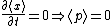 . Or just remember the momentum of a stationary state is zero. . Or just remember the momentum of a stationary state is zero. |  | radicaltyro
2006-10-30 23:17:29 | As Griffiths says, "As Peter Lorre would say, Do it ze kveek vay, Johnny!'".  but but  for the infinite square well, so for the infinite square well, so  . . | |
|
|
Comments |
MuckFluck
2012-10-08 13:38:56 | There is no preferred direction for the momentum, so by symmetry its mean must be 0. Compare with the classical case: The particle is equally likely to move in either direction at any instance since it bounces back and forth.
justin_l
2013-10-15 22:01:13 |
This was the way I saw it and the way I think was fastest; it's a straightforward argument from symmetry.
|
djh101
2014-08-30 00:20:58 |
Isn't symmetry wonderful?
|
|  | Banedon
2010-11-05 03:50:42 | This alternate solution is something I found while fiddling with the question - it seems the expectation value of the momentum operator, on all fully real wavefunctions, is zero. Here's why:
The momentum operator is Hermitian, which means its eigenvalues must be real. But the momentum operator also has the imaginary number "i" in it. With the expectation value as , and with the wavefunction completely real, there won't be anything to cancel the "i" in front of the whole expression. That means the entire expression must be zero, the only number that when multiplied by "i" returns a real number.
This proof seems rather weird, especially since one would expect something as significant as this to have been mentioned in a textbook. However, I've not been able to find a counterexample (in fact all the fully real wavefunctions I've found in Griffiths logically have expectation value of momentum = 0), and it makes sense, and most importantly of course it gives the right answer, so ...
Banedon
2010-11-05 03:52:09 |
Meant to right "with the expectation value as (psi l P l psi).
|
| | carle257
2010-04-09 23:45:01 | Also recall that the solutions when taken as pure states of only one n form stationary states of which the time derivative of all expecation values will be zero. Then . Or just remember the momentum of a stationary state is zero. | | radicaltyro
2006-10-30 23:17:29 | As Griffiths says, "As Peter Lorre would say, Do it ze kveek vay, Johnny!'". but for the infinite square well, so . | | tera
2006-08-21 05:28:40 | The expectation value of p is zero because otherwise the particle would tend either to go to the right or left and leave the well potential which is impossible!!!!! | | jcain6
2005-11-22 18:58:36 | The expectation value of p must be real. When the integral is set up, complex number i can be factored out to the front of the integral. With i in front of the integral the only way for the expectation value of p to be real is for the integral to produce imaginary numbers or for the integral to equal zero. Since there is no hope that the integral will produce complex numbers in this case the expectation value of p must be zero. Just a way to save a little time!
a19grey2
2008-11-02 11:13:07 |
Yeah, this is the fastest way for me to do it. Also, it applies more generally and it says that the expectation of the momentum will be zero any time that the derviative with respect to x doesn't bring out any factors of i.
|
| |
|
| Post A Comment! |
|
|
Bare Basic LaTeX Rosetta Stone
|
LaTeX syntax supported through dollar sign wrappers $, ex., $\alpha^2_0$ produces  . .
|
| type this... |
to get... |
| $\int_0^\infty$ |
 |
| $\partial$ |
 |
| $\Rightarrow$ |
 |
| $\ddot{x},\dot{x}$ |
 |
| $\sqrt{z}$ |
 |
| $\langle my \rangle$ |
 |
| $\left( abacadabra \right)_{me}$ |
_{me}) |
| $\vec{E}$ |
 |
| $\frac{a}{b}$ |
 |
|
|
|
|
The Sidebar Chatbox...
Scroll to see it, or resize your browser to ignore it... |
|
|
|